
How to Price Your Handmade Leather Goods: A Complete Guide
How to Price Your Handmade Leather Goods: A Complete Guide
Based on the YouTube tutorial “How to Price Your Leather Goods” — a practical walkthrough using a handcrafted card wallet as the example.
If you make leather goods to sell, figuring out what to charge can feel like guesswork. Price too low and you’re barely covering materials. Price too high and you worry nobody will buy. The truth is, there’s a straightforward formula — and it doesn’t rely on gut feeling.
This guide breaks down the complete pricing framework using a real example: a handstitched card wallet made from Hermann Oak English Bridle leather.
Quick Reference: Here’s the full pricing framework at a glance.
(1600×2400 infographic — save or open in a new tab for full detail)
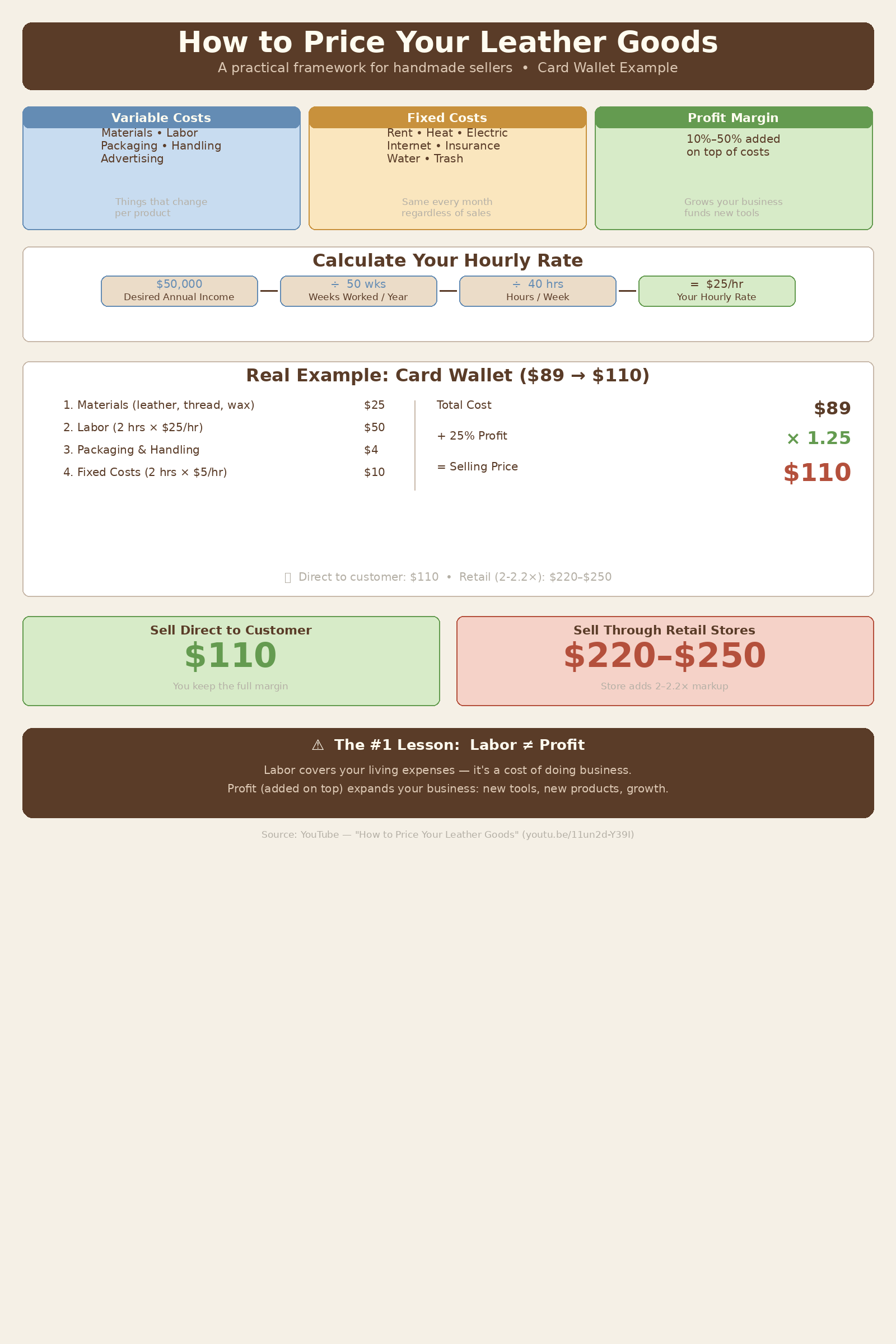
The Three Categories of Cost
Every product you make has three layers of cost you need to account for:
- Variable costs — things that change per product
- Fixed costs — expenses that stay the same month to month
- Profit margin — what grows your business
Let’s walk through each one.
1. Variable Costs: What It Actually Takes to Make One Item
Variable costs are expenses that change with every product you make. Different products use different materials, take different amounts of time, and need different packaging.
Materials
First, figure out exactly how much material goes into one piece. For our card wallet example:
- Leather: ~1.5 square feet of Hermann Oak English Bridle in London Tan
- Thread, wax, and small consumables
- Total material cost: $25
Pro tip: Use a leather supplier like Weaver that offers leveling services (they’ll cut your leather into consistent strips at your desired thickness) — this makes material calculation much more predictable.
Labor — The Big One
This is where most new makers get it wrong. Your labor rate isn’t pulled from thin air — it’s based on what you need to live.
Here’s how to calculate your hourly rate:
Target Annual Income ÷ Weeks Worked ÷ Hours per Week = Hourly Rate
      $50,000        ÷      50      ÷       40       =    $25/hr
Adjust the numbers to your situation:
- Want two weeks off? Work 50 weeks per year.
- Prefer a 30-hour work week? $1,000 ÷ 30 = $33/hr.
- Have specialized skills or a degree? Factor that in as a premium.
For our wallet: 2 hours × $25/hr = $50
Packaging and Handling
Don’t forget the little things:
- Packaging materials (fabric bags, plastic bags, boxes): $1
- Handling (packing, printing labels, driving to the post office): $3
That 30-minute round trip to the post office is labor — don’t give it away for free. Split it across your shipments.
Advertising (if applicable)
If you use Facebook Ads or other paid promotion, factor that into the price. For example: if every $10 in ads sells one wallet, add $10 to the price.
2. Fixed Costs: The Overhead You Can’t Ignore
Fixed costs don’t change whether you sell 10 items or 100. They include:
- Shop rent (or the percentage of your home used as a workshop)
- Heating, electricity, internet
- Insurance, water, trash
How to account for them:
- Add up all your monthly fixed costs
- Divide by 160 (40 hours × 4 weeks)
- Add that dollar amount to your hourly rate
In our example: $5/hour — so for a 2-hour wallet: +$10
This way, as long as you’re working, your pricing covers your overhead.
3. Profit Margin: The Piece Most Beginners Miss
This is the most important thing in this entire guide:
Your labor is NOT your profit.
Your labor cost pays your rent, groceries, and bills. It’s a cost of doing business — not a reward. Profit is added on top, and it’s what you use to:
- Buy better tools
- Expand your workshop
- Develop new products
- Grow your business
Your profit margin can be 10%, 25%, 50% — whatever fits your goals. If you’re just starting out with few tools, aim higher. The faster you build your workshop, the more efficient you become, and the more competitive your pricing can be later.
Think of it like a new bourbon distillery: they charge premium prices for young whiskey to bankroll their operation and build aging inventory. Same principle applies here.
Putting It All Together: The Card Wallet
Here’s the complete math for our example:
| Item | Cost |
|---|---|
| Materials (leather, thread, wax) | $25 |
| Labor (2 hrs × $25/hr) | $50 |
| Packaging | $1 |
| Handling (packing, label, post office) | $3 |
| Fixed costs (2 hrs × $5/hr) | $10 |
| Total Cost | $89 |
Now add profit:
| Line | Amount |
|---|---|
| Total Cost | $89 |
| × 1.25 (25% profit margin) | $110 |
Selling Channels
Where you sell changes the final price tag:
| Channel | Price | Who Gets What |
|---|---|---|
| Direct to customer (your own shop, markets) | $110 | You keep the full margin |
| Retail / wholesale (boutiques, stores) | $220–$250 | Store adds 2–2.2× markup |
That’s why handmade leather goods can seem expensive in stores — the retailer needs their margin too.
The Bottom Line
Here’s what separates a hobby from a sustainable business:
- Track every cost — materials, time, packaging, overhead. Use a worksheet.
- Know your hourly rate — it’s based on what you need to live, not what you think the market will bear.
- Profit is separate from labor — labor keeps you afloat, profit lets you grow.
- Price for the channel — $110 direct, $220–$250 in stores. Both are fair when the math is done right.
“This is the difference between just skirting by and making it work and actually having a healthy business that you can grow and move into different places.”
Based on the YouTube video “How to Price Your Leather Goods” — a leathercraft maker walks through their real-world pricing process while making a card wallet from Hermann Oak English Bridle.